Menu Knowledge
The point is not to just study for some arbitrary test. It is to be able to confidently answer questions guests will actually ask.
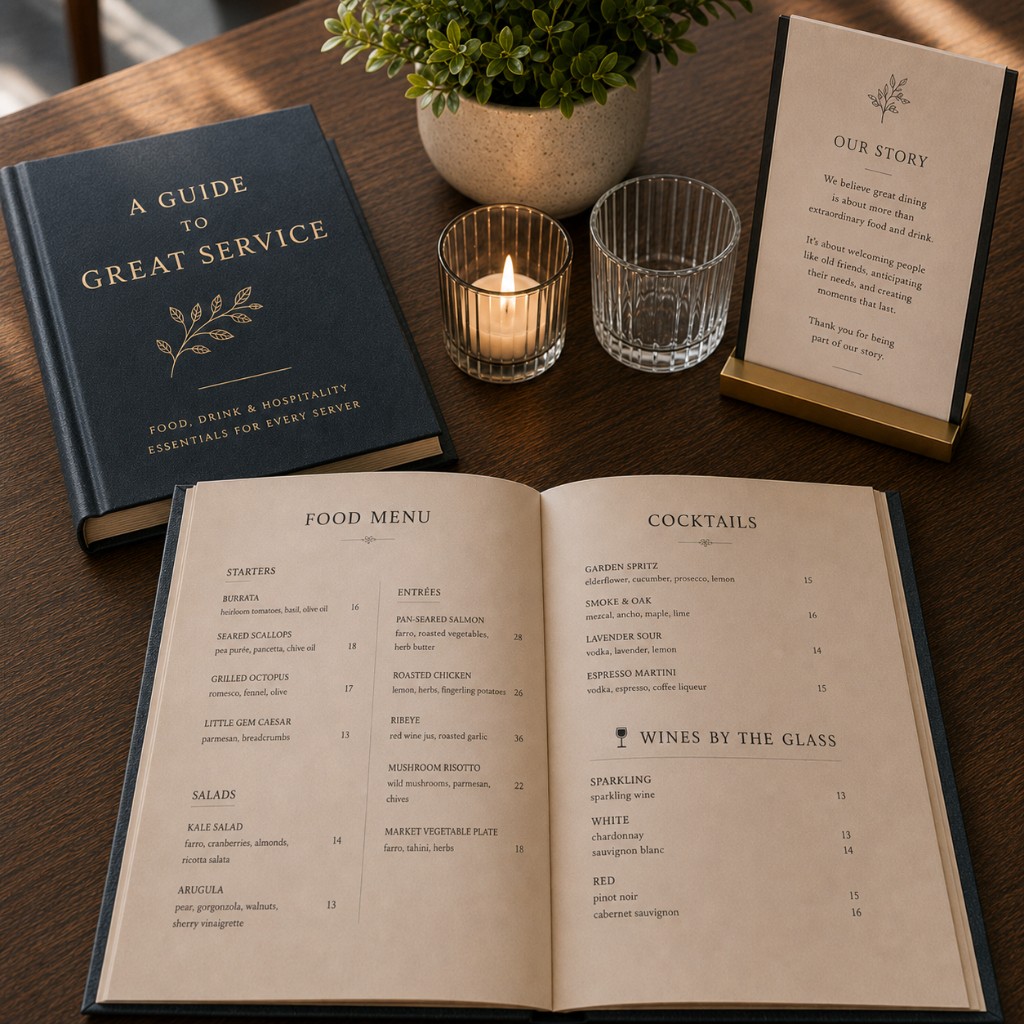
It is important to understand why the restaurant exists, its story, and the principles that guide it. This will help you connect with the restaurant and share its story so your guests will too.
You should know the names of each dish, the ingredients that make it up, relevant cooking techniques, allergen information, and allowable modifications.
Your menu might contain ingredients, cooking techniques, or other words that your average customer might not be familiar with.
You should know how to pronounce them and be able to explain in simple terms what they are/mean.
Most restaurants have a set of cocktails that are unique to them.
You should know what they are called, what the base spirit is, the main ingredients, and what the flavor profile is (sweet, spicy, spirit forward, tart, well balanced, etc).
For these wines you should know:
- -The producer
- -The name of the wine
- -The grape variety/varieties in it
- -Where it comes from (country and region)
- -Distinguishing characteristics (oaked/unoaked, sweet/dry, still/sparkling, fruit forward or mineral/earth driven, acid level, tannin level, etc.)
- -The price
In most restaurants you are not expected to know the whole spirits list or wine bottles list.
However, that does not mean that you don’t need to know any.
A good rule of thumb is to know three of each spirit, three red wines by the bottle, and three white wines by the bottle that you are familiar with and can recommend to your guests.
Having these ready to go makes for a better guest experience and can easily raise check averages.